

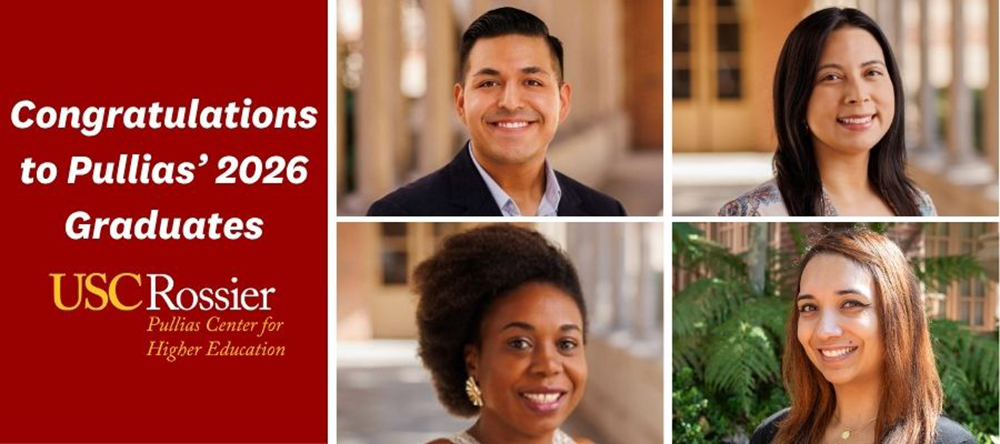
This May, the Pullias Center is proud to have three of our hard-working Ph.D. students graduating from the Rossier School of Education, as well as staff member Christine Rocha graduating from Rossier with her Ed.D. Please join us in offering our sincerest congratulations to all — including Ph.D. students Jimmy Aguilar, Leila Carranza and Glenda Palacios Quejada. Now, with doctoral degrees in hand, these new grads reflect on their time at the Center and share their future plans to promote equity and positive change in higher education.
Jimmy Aguilar
How do you feel about graduating from Rossier after four years?
It feels a little disorienting in the best way. On one hand, the Ph.D. has felt like it has taken forever, especially when you measure time in peer review cycles and revise-and-resubmits. On the other hand, the four years moved quickly once the work found its rhythm. I feel deeply grateful for the support I have received from Rossier and the Pullias Center, and for the people who made the process both rigorous and sustaining. It is bittersweet to leave, but I also know I will always have a home on the 7th floor of the Pullias offices at USC.
What has been the most impactful experience you’ve had since you’ve been a student here?
Presenting my dissertation research at the 2026 USC Conference on Enrollment Research, Policy and Practice (CERPP) stands out as a defining moment. I was part of a panel on technology and AI in enrollment management alongside senior leaders and practitioners, speaking directly to audiences responsible for shaping admissions policy and practice. That setting made the stakes of the work immediate. It was one thing to study these systems; it was another to share findings in a space where those insights could inform ongoing decisions about equity and access. It felt like a culmination of the Pullias model of research that stays in conversation with practice.
What’s one of your favorite memories of working with other students and faculty members?
My advisor and I bonded early over a shared frustration with the office Keurig, which neither of us considered acceptable coffee. As the Posselt research team grew, that frustration turned into a collective project. One week, we all drove to Glendale, sat through a full coffee tasting at Sur La Table, and debated espresso machines with the level of seriousness we usually reserve for research design. It was equal parts unnecessary and completely essential. That moment captures the spirit of the group: collaborative, particular about what we care about, and willing to invest in the small things that make a shared intellectual space feel like a community.
How has your USC Pullias/Rossier experience changed you as a researcher/scholar?
My work has remained focused on expanding access for students historically excluded from higher education, but my analytic approach has shifted in important ways. I entered the program grounded in admissions practice. At Pullias, I deepened my focus on organizational behavior and the institutional technologies that shape decision-making processes and outcomes. That shift reframed my questions toward how systems operate, not just who they include or exclude. I have also been fortunate to be trained within a lineage of organizational scholars working at the intersection of sociology and education policy, which has shaped how I think about institutions, power and the possibilities for change.
What are your plans post-graduation?
My next step is to continue building a research agenda focused on higher education access, organizational decision-making, and admissions equity, particularly in ways that engage institutional practice and policy conversations and extend the reach of my dissertation work across academic and professional audiences.
Glenda Palacios Quejada
How do you feel about graduating from Rossier after 4.5 years?
I feel highly prepared, particularly in the areas of policy evaluation and quantitative research methods, grounded in rigorous and critical training. Throughout my doctoral studies, I developed strong analytical and methodological skills through an integrated set of coursework and research experiences in experimental methods, econometrics, hierarchical linear modeling, survey design and program evaluation.
This preparation has strengthened my ability to approach policy questions with both technical rigor and contextual sensitivity. I am confident in my ability to contribute as a policy evaluator, consultant, and faculty member, especially in my home country of Columbia, where the number of Ph.D.-trained professionals remains limited. I am eager to apply the knowledge and skills I have gained to support evidence-based policy and contribute to meaningful work in line with the values and guidance of my mentors and advisors, Tatiana Melguizo, Morgan Polikoff and Pedro Noguera.
What has been the most impactful experience you’ve had since you’ve been a student here?
One of the most impactful aspects of my experience has been having both the time and institutional support to conduct research, as well as opportunities to engage directly with policymakers about the policies I was studying. For example, I participated in community college meetings with my advisor, Tatiana Melguizo, which gave me direct exposure to how research enters policy discussions and decision-making spaces.
These experiences allowed me to move beyond analysis on paper and develop a deeper understanding of how research informs real-world decisions in practice. They also helped me feel more closely connected to the communities behind the data, and to think more intentionally about how my work can contribute to more equitable and contextually grounded policies.
What’s one of your favorite memories of working with other students and faculty members?
One of the most meaningful moments in my time here came during a very difficult period, when my advisor, Tatiana Melguizo, passed away. What stands out most is the extraordinary support I received from faculty and peers during that time. Professor Morgan Polikoff and Dean Pedro Noguera stepped in as advisors, and, along with other faculty members, including Julie Posselt, Zoë Corwin and Steve Desir, offered guidance, encouragement and a strong sense of continuity in my academic path.
That experience reinforced for me how collaborative and supportive this community is. It shaped not only how I navigated that period, but also how I think about mentorship and the kind of academic colleague I hope to be.
How has your USC Pullias/Rossier experience changed you as a researcher/scholar?
Being part of Pullias has profoundly shaped my academic trajectory. I received rigorous methodological training, learned to engage meaningfully with policymakers and practitioners, and developed a deep appreciation for the importance of human-centered relationships in research.
I also benefited from significant institutional support that allowed me to advance my research agenda. As a recipient of the Provost Fellowship and the Diversity, Inclusion and Access (DIA) Fellowship, as well as internal research funding from the USC Rossier School of Education and the Center for Latinx and Latin American Studies, I was able to pursue projects on ethno-education policies in Colombia, the experiences of Afro-Latinx students in U.S. higher education, and the relationship between ethnic studies coursework and academic outcomes.
These experiences not only strengthened my research but also helped me refine a scholarly agenda focused on equity, culture and education across contexts.
What are your plans post-graduation?
After graduation, I will begin a postdoctoral position at Universidad de los Andes under the supervision of Professor Diego Lucumí. Our work will focus on understanding how Afro-Colombian children in the Pacific Coast region grow, learn, and thrive in contexts shaped by poverty, violence, and long-standing structural inequalities. I have also been selected as an early-career scholar for the 2026 Jacobs Foundation LEVANTE Program, through which I will collaborate with international partners to develop a research proposal on learning variability.
Christine Rocha
How do you feel about graduating from Rossier after both being a student and a staff member for 12 years?
I feel like I learned a lot from students, staff and faculty over the years. I have been able to get to know the Rossier community deeply, collaborate with many, and learn from many students, staff and faculty. Having attended graduate school at Rossier, I feel like I got an opportunity to find community inside the classroom, as well as the Pullias Center, while we navigate changes and obstacles our country underwent over the years that have affected many, both at USC and at home.
What has been the most impactful experience you’ve had since you’ve been a student here?
I started working at the Pullias Center when I was a work-study undergraduate student at USC. I think the most impactful experience I have had since then is growing as an individual, both personally and professionally, along with others at the center. The Pullias Center became my place of study and home away from home. I am grateful to have had the opportunity to really get to know students, staff, and faculty as people rather than their working title only. As Rossier graduate student, I got to know a different side of faculty, as now I had become a student in their classroom where I learned more about their research expertise. Having the opportunity to work at Rossier and be a student is an experience I will never forget.
What’s one of your favorite memories of working with other students and faculty members?
As a former I AM student, one of my favorite memories working with Rossier community must be when I oversaw the I AM Mentoring Program. My job was to recruit USC students, staff and faculty to mentor high school students attending LAUSD schools in the surrounding community of USC. I had the opportunity to work with new and returning mentors who were committed in supporting students who were applying to and enrolling into college. Seeing the commitment and level of impact our mentors had on I AM students was truly inspiring. Being a leader in this capacity allowed me to get to know the Rossier community in a different manner.
How has your USC Pullias/Rossier experience changed you as a researcher/scholar?
As a first-generation student, I never thought research was an area I would work in or that I would pursue a doctoral degree. The Pullias Center has pushed me to grow as a scholar. I was able to collaborate with faculty in various research projects that helped me strengthen my skills as a writer and researcher since an undergraduate student. I have been able to use my research skills and publish manuscripts along with my colleagues on various topics that are meaningful and important to today’s society.
What are your plans post-graduation?
I will continue working with Dr. Zoe Corwin on the PASS Project. Beyond the PASS Project, I plan to pursue a new role that will allow me to apply my research skills in practice to drive change in higher education.
Congratulations to our 2026 graduates! As the Pullias Center moves into the summer, our researchers, faculty and staff invite you to visit our website, follow us on social media (Linkedin, Facebook, X, and Bluesky), and sign up for our newsletter to keep up to date with the Pullias Center’s research and practice.