

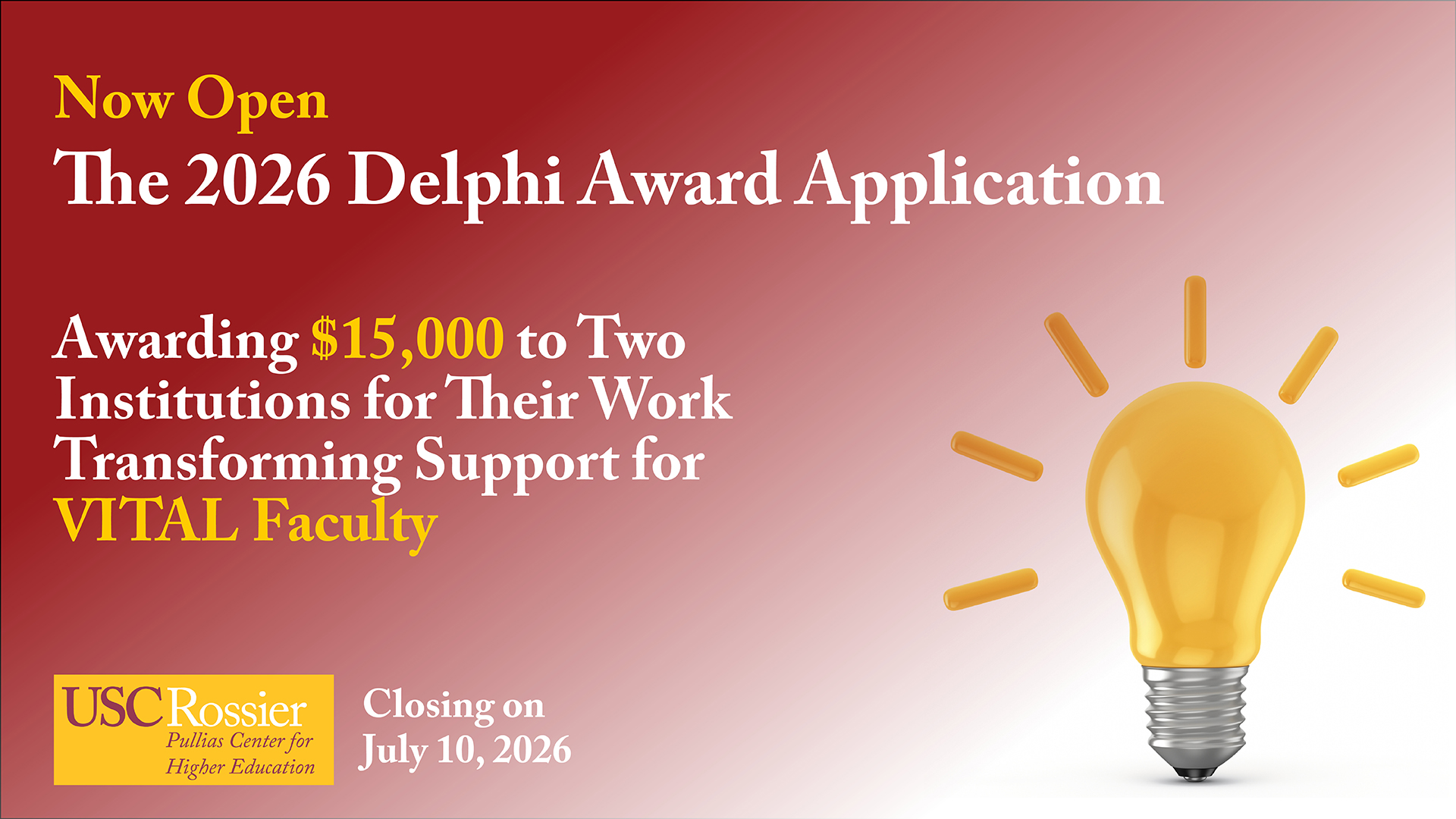
The application period for the 2026 Delphi Award is now open. The Award is presented annually to two institutions that have created policies, practices and programs that ameliorate the issues facing VITAL (visiting, instructors, teaching, adjunct and lecturers) faculty, also known as contingent/non-tenure-track faculty.
The Award is given annually by the Pullias Center for Higher Education, in partnership with the American Association of Colleges & Universities (AAC&U), and generously sponsored by OneHE and Adjunctions.
Learn more about the Award guidelines, the applications details and access the application here. The 2026 application will close on Friday, July 10 at 5pm PT and winners will be notified in Fall 2026.
This is the ninth year for The Delphi Award, an initiative of the Delphi Project on the Changing Faculty and Student Success at the Pullias Center. The Award is an extension of the Delphi Project’s mission to better support faculty off the tenure track (also known as VITAL faculty) while helping create new faculty models for postsecondary institutions to adopt. The USC Pullias Center for Higher Education has worked in partnership with AAC&U on the Delphi Project since the Project’s inception in 2012, developing reports and resources, collecting models and conducting research and advocacy on this issue.
Instructional faculty in American higher education is mostly comprised of VITAL professionals responsible for teaching the vast majority of college and university classes. These instructors are typically hired on short notice, on short-term or no contracts, and paid less than tenured or tenure-track faculty, while offered little or no orientation or mentoring, professional development, or voice in governance. As a result, VITAL faculty are often tasked with balancing heavy teaching loads at multiple institutions despite limited time to prepare courses and limited support their curriculum design or pedagogy — factors shown by Delphi Project research to correlate with lower student success rates.
Additional tools and resources from the Pullias Center and the Delphi Project to assist campuses in supporting non-tenure-track faculty include Departmental Cultures and Non-Tenure-Track Faculty: A Self-Assessment Tool for Departments and Non-Tenure-Track Faculty on our Campus: A Guide for Campus Task Forces to Better Understand Faculty Working Conditions and the Necessity of Change. Case Studies of all Delphi Award winners, including 2024 winners Michigan State University’s College of Arts & Letters and the University of Massachusetts Amherst and finalists San Jacinto College and the University of Delaware, are also available on the Pullias Center website.