

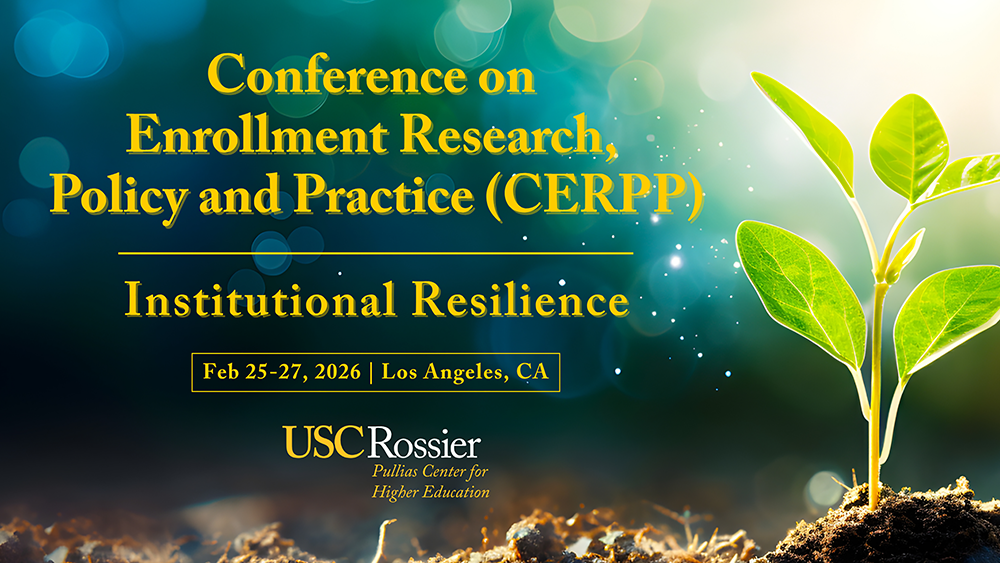
For 18 years, the annual USC Conference on Enrollment Research, Policy and Practice (CERPP) has offered a unique space for the field of enrollment management. In coordinating the conference in recent years with Dr. Emily Chung, she and I have remarked on the frequency we have heard attendees make a specific observation: CERPP creates a way to gather that is more trusting and candid than is typical in the profession. During and following our meeting February 25-27, it took both hands for me to count the number of times people commented to me on this.
There are a hundred reasons right now for admissions and financial aid professionals to choose caution, silence, or withdrawal — and as many reasons why we need each other more than ever.
Core features of the admissions profession work against trust and candor. The system rewards caution, competition, controlled disclosure, and (by definition) selectivity rather than openness. Sharing too much — whether it is about strategy, discount rates, or lessons learned from the school of hard knocks — can feel like giving away advantage. Guardedness is natural.
Admissions professionals are also communicators of a certain sort. Their job is to present institutions in their best light. It’s an essential skill for recruitment and ambassadorship, but it can normalize a communication style of external messaging rather than normalizing honest dialogue. When you spend much of your time crafting compelling narratives, turning off that instinct and speaking with unfiltered transparency is a choice.
How has CERPP been able to create a trusting, candid space year after year, to help create a more grounded center for the field? Whether you are part of this community or you’re in the business of convening others in higher education, here are strategies we’ve drawn upon, connected to highlights of this year’s meeting:
- Keynote speakers who lead by example — Each year, we identify speakers whose own candor and courage will set the tone of real talk at the start of day one that we seek for the meeting as a whole. This year, Dr. Kedra Ishop shared lessons in resilience from each of the institutions where she has led, and her honesty opened the space for real honesty from everyone else in the room.
- Safety — Without designing environments for confidentiality and mutual benefit, it’s difficult for trust to deepen beyond surface-level exchange. We opted for confidentiality over media publicity with this meeting, for example, and attendees agreed to the principle that “what’s said here will stay here, but what’s learned here should leave here.”
- A program inspired by potent community needs — By leaning into real tensions and pain points, and selecting panelists and moderators whose success is defined in part by their character, we try to draw out how excellence is embodied. From our annual themes (this year: Institutional Resilience) to the construction of individual sessions, to iterating in advance together on the main points each speaker will make, we try not to stop at topics and ideas that are safe. Historically, this was made possible by our founding director Jerry Lucido’s deep well of experience and deeply caring way with his colleagues in the enrollment management community.
- Always open to partnerships — If a center is an organizing influence, it’s natural to ask: Organizing whom? We have a rich community of stakeholders who are attuned to our interdependence. For example, in addition to attendees who represent the worlds of research, policy, and practice, we are able to make the meeting possible financially in an otherwise difficult year through sponsorships from Huron Consulting Group, The College Board, and others. With support from the Russell Sage Foundation and Mellon Foundation, we also hosted a pre-conference that gathered a select group for a research-practice partnership on the future of college admissions that I am fortunate to be building with The Urban Institute and the Association for Undergraduate Education at Research Universities.
- Cross-sector, by design — Finally, as the “research, policy, and practice” in our name suggests, we elevate multiple community stakeholder perspectives and do our best to weave them into a common conversation. This reduces the pressures of competition and posturing, and allows us to see systems at work. A great example of this at our 2026 meeting was the session on AI and Technology in Enrollment Management, which featured a Pullias research associate, a seasoned enrollment leader, an AI start-up, and a community organizer. You can read more about this terrific session here.
- Together in mission — And last but definitely not least, CERPP attracts and serves education leaders who are dedicated to that part of their institutional missions emphasizing greater access and opportunity. Whatever challenges they may face that demand pragmatism, our shared commitment to these values — along with a shared optimism around possibility, purpose, and progress in education — enables people from otherwise “competing” institutions to bring their challenges and solutions alike to this forum.
What I have witnessed this year has affirmed something equally important: that what gave this conference its influence in the field was not its affiliation with any organizational structure but the spirit of candor, courage, and trust you can feel in the space we create together, which we intend to continue doing.