


For the last 30 years, USC Rossier’s Pullias Center for Higher Education has been a leader in promoting the success of students who have traditionally not been well served by higher education. It has done so in two ways: by studying distinctive populations to understand their unique needs, and by uncovering how campuses have not been designed to serve these students and must be redesigned and transformed to do so.
In terms of the distinctive populations, the Center has explored and continues to study the experiences of racially minoritized, LGBTQ+, undocumented, low-income, gang-impacted and justice-impacted students, as well as students experiencing homelessness, students with foster care experience, students navigating mental health challenges and student parents. Our faculty often studied these groups before most campuses and organizations recognized their need for particular supports and their insights have transformed how the field understands the needs and services these groups require. As an example, a recent policy brief on California legislation found that, for students with foster care experience, financial aid often arrives too late to cover housing or institutional payments, which can leave students unable to enroll. The Center also created practitioner briefs and policy documents to rethink current processes and policies, shaping new approaches across the country.
Just as important has been the Center's focus on transforming campuses to better support students and bucking the trend of creating small and boutique programs on the “side” to support these underserved student groups, leaving the campus largely the same. Past efforts simply have not been systemic enough to address the myriad problematic policies, processes, structures and even values, and thus have not matched the challenge. Many funders and national organizations now support and understand the need for campus redesign, which is encouraging. For the last three decades, Pullias research on the need for transformation has helped create this change in perspective. Several efforts demonstrate our focus on campus transformation, including the California State University STEM Collaboratives, the PASS Project and the Shared Equity Leadership Project.
One publication that demonstrates this perspective is “Creating a Diverse Student Success Infrastructure.” In this report, I drew on several of my previous studies of success among underserved populations to explore the type of redesign needed in order to truly serve these long poorly served groups by creating culture change, which is the key to properly serving such groups. The report outlines all the key areas of campus that can be mobilized to ensure that the campus can change the key underlying financial, human and physical resources needed to alter support. If campuses' priorities, resource allocation, energy, planning and policy are focused on diverse student success, then campuses can create a culture conducive to fostering diverse student success. A campus is unlikely to be ready to create and sustain change related to student success if it lacks the basic infrastructure. Every campus is already guided by an infrastructure, but it is typically not directed toward underserved students. The main aspects of a campus infrastructure are planning; governance and decision-making; policy; finance and resource allocation; information and institutional research; facilities and information technology; human resources and development; incentives and reward structures; and metrics and accountability. These can be redesigned to support underserved students.
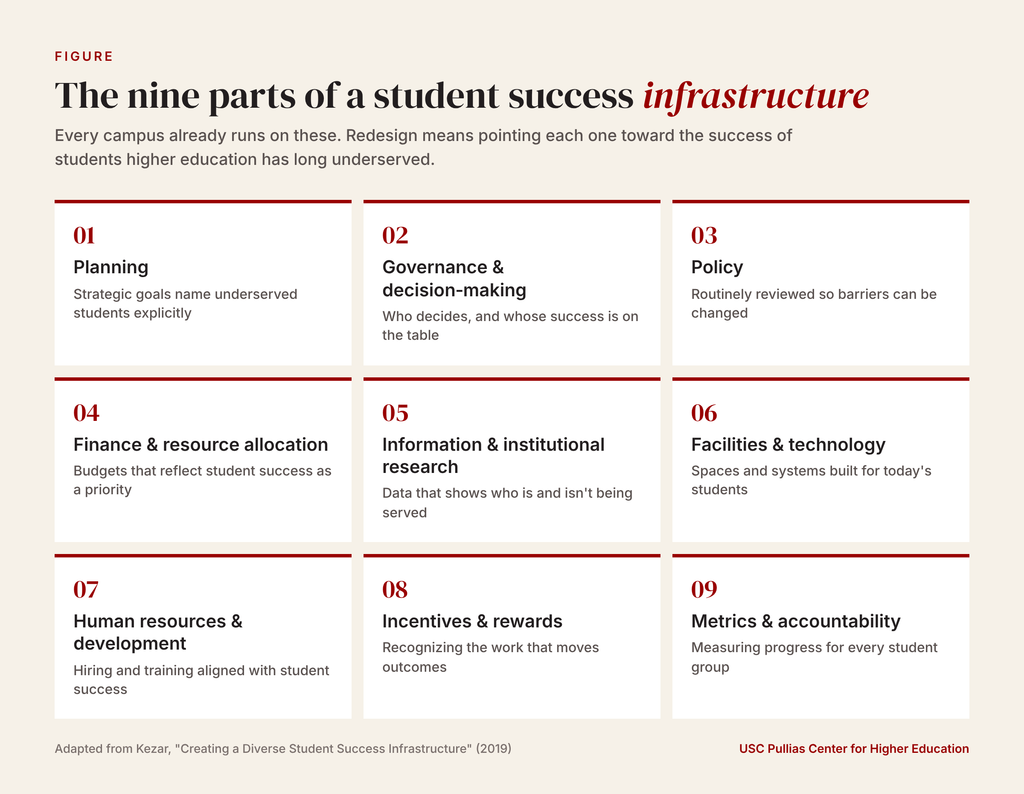
As an example, policy shapes the actions of faculty and staff and creates the conditions in which student success can be established or not. If policies are examined routinely, then ones that create barriers can be changed. Because policies establish the possibilities for action, they are a strong driver of systems and cultural change. Another example is finances. Resource allocation reflects institutional priorities, and if decisions related to finances do not foreground student success, then the campus is unlikely to make progress in this area. The diverse student success infrastructure elements share similar features that enhance effectiveness, including equity, alignment, broad stakeholder engagement, collaboration, learning, clarity and transparency.
Very closely tied to a student success infrastructure is shared equity leadership. Shared equity-oriented leadership is central to the change process. In fact, shared, equity-oriented leadership is a prerequisite for creating a diverse student success infrastructure, and without leadership, forward movement on this issue is a challenge. Studies of transformational change have consistently identified shared or team leadership — across administrators, faculty, staff and students — as central to implementing changes, as I found in my 2018 book “How Colleges Change.” Changes to support diverse students consistently emphasize leaders who foreground equity. Why is shared and equity-oriented leadership so critical to transformation? Leadership defines the values, direction and priorities of an organization. Leadership establishes an institution’s willingness and ability to identify, develop, implement and support a strategic agenda focused on student success.
Higher education continues to struggle with serving these populations, and the need for redesign remains critical. What has changed is the appreciation for a different approach and sets of campuses that can serve as models — that have transformed — to guide others. Campuses have a better awareness, for example, of ways to support low-income and racially minoritized students than previously. Many of the students we have long studied, including student parents, students with foster care experience and justice-impacted students, share many of the characteristics of what national organizations and philanthropic groups now call post-traditional learners. Pullias was doing this work long before the term existed. Our Center's new focus on adult and working learners, who balance college with paid work, builds directly on that foundation and meets the challenge of the moment. As we have throughout our history, we will champion overlooked groups, and we will do so in ways that ensure their success and thriving through intentional transformation.